


Forecr Jetson AGX and IGX Thor: Carrier Board or Box PC?
TARGET TechNews · Updated
Selecting a Forecr system based on Jetson AGX Thor involves more than AI compute performance. Evaluate T4000/T5000, IGX T5000, carrier-board and Box PC options against camera interfaces, power budgets, thermal design and integration responsibilities.
Two Thor approaches to Edge AI
Jetson T5000 delivers the highest performance tier in the family for intensive AI workloads. Jetson T4000 provides a strong alternative for tighter power budgets, while compatible IGX T5000 options add industrial-grade capabilities to the same design.
A top performance tier for intensive AI workloads, with 128 GB of memory and NVIDIA Blackwell architecture.
A balanced Edge AI option with 64 GB of memory, combining performance, power consumption and system size.
128 GB of memory, full DRAM ECC, real-time Linux and extended lifecycle options.
Performance figures are NVIDIA's stated maximum sparse FP4 AI compute values. Actual performance may vary with power mode, software and system configuration. IGX capabilities are defined at NVIDIA platform level; the final system configuration must be verified against project requirements.
Thor in two system formats, from carrier board to Box PC
Forecr offers the NVIDIA Jetson AGX Thor platform as a carrier board for custom integration or as a deployment-ready Box PC. The industrial series supports Jetson T4000/T5000, while the military series extends to Jetson and IGX T5000 options.
BOARD LEVEL
DSBOARD for industrial projects; MILBOARD with Jetson AGX and IGX Thor support for defense and avionics integration.
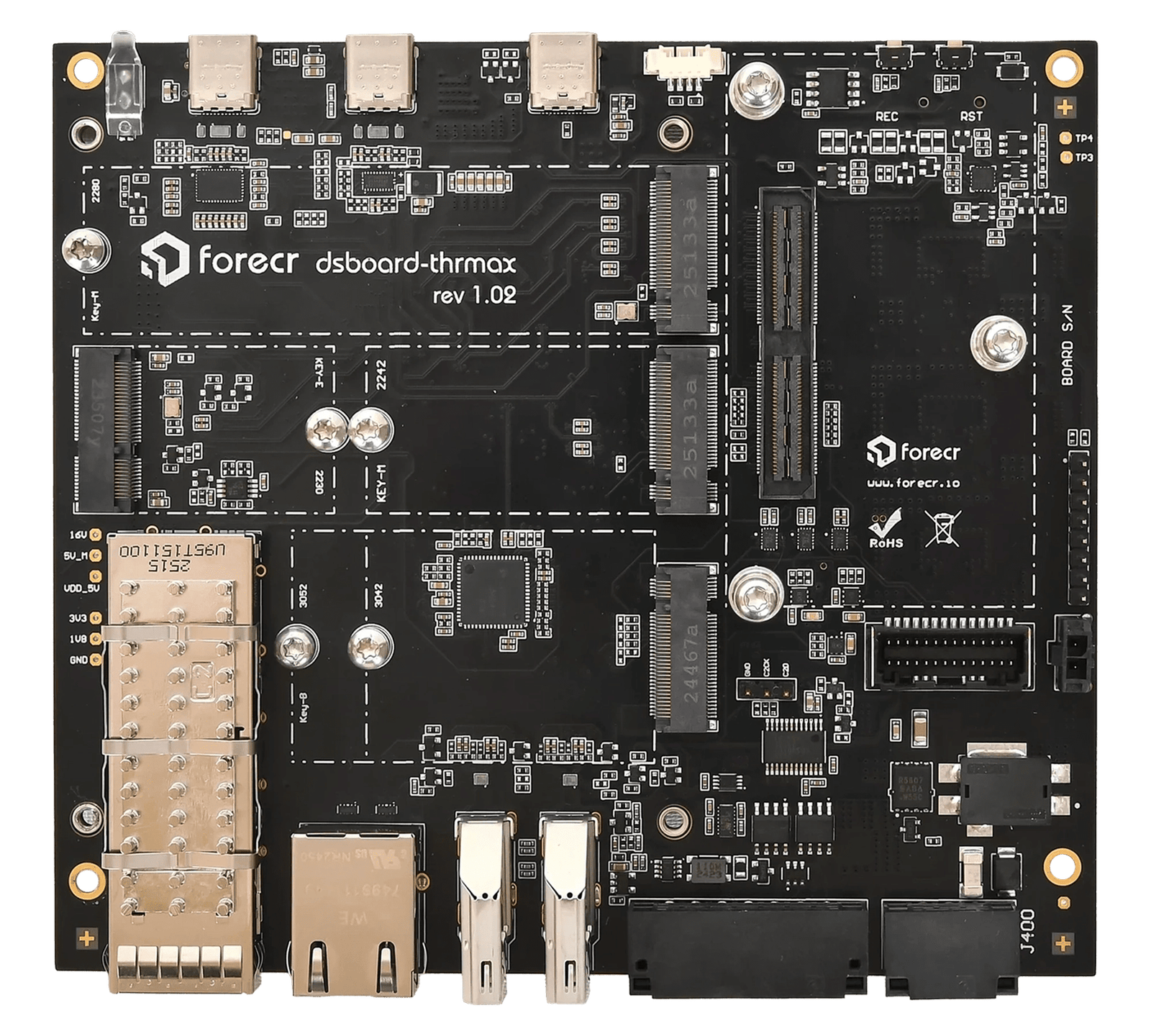
DSBOARD-THRMAX
A compact and flexible carrier board for teams developing custom enclosure, power and camera architectures around NVIDIA Jetson AGX Thor.
View product page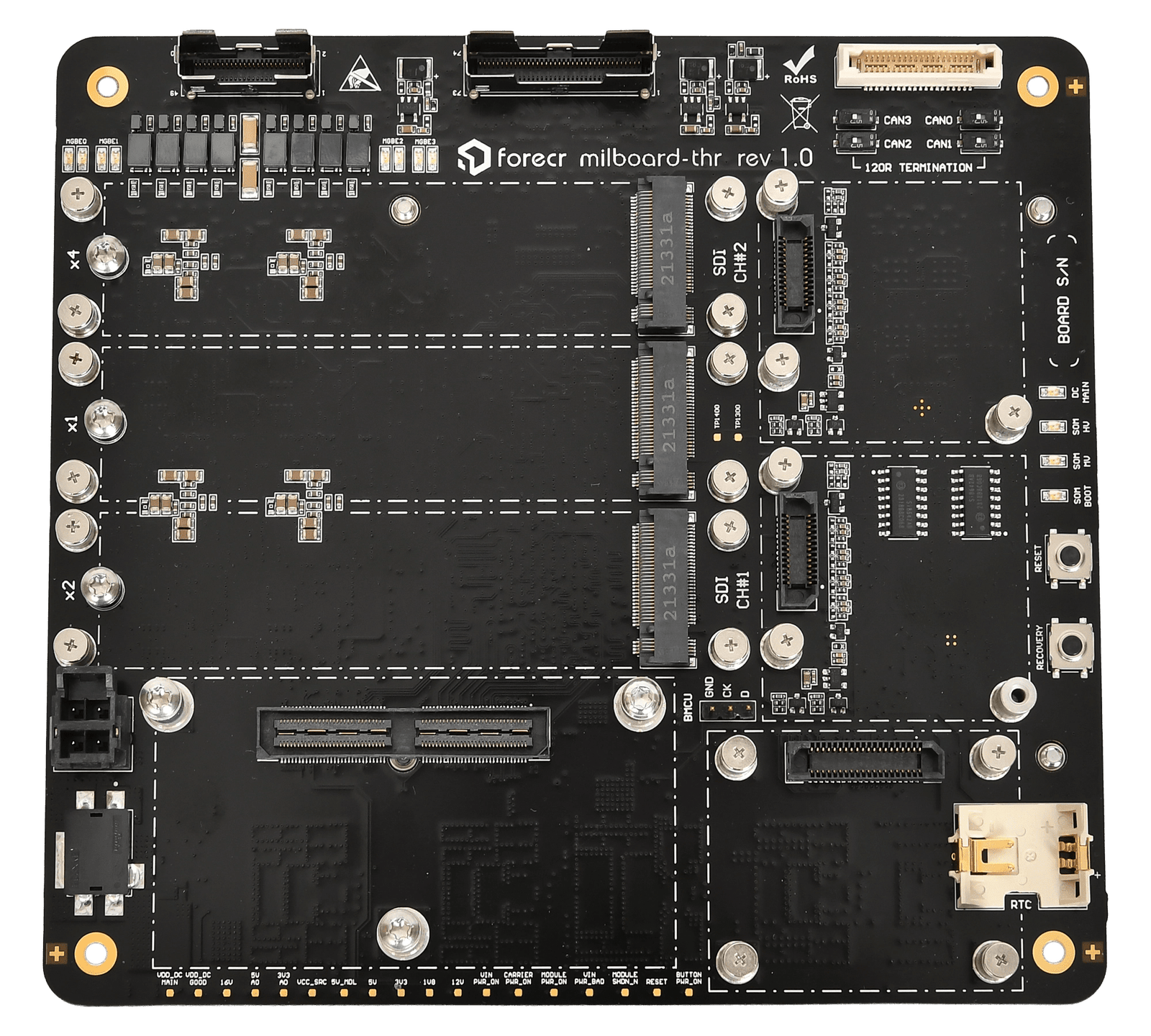
MILBOARD-THR
A ruggedized board platform that brings NVIDIA Jetson T4000/T5000 and IGX T5000 to avionics and defense projects.
View product pageBOX PC LEVEL
DSBOX for industrial systems; MILBOX for Jetson AGX and IGX Thor applications in demanding field conditions.
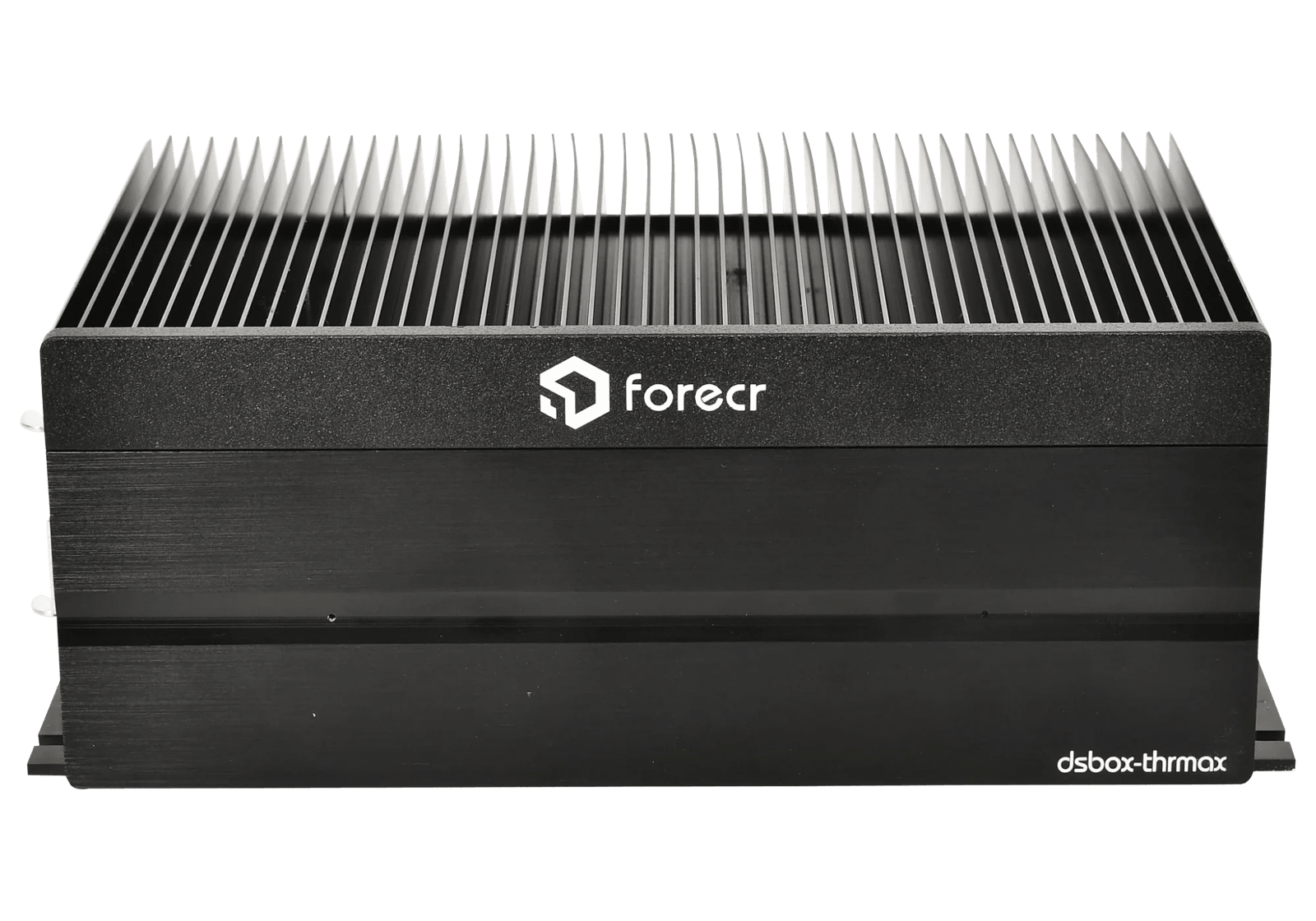
DSBOX-THRMAX
Turns NVIDIA Blackwell-based Jetson AGX Thor performance into a thermally managed, deployment-ready Edge AI computer.
View product page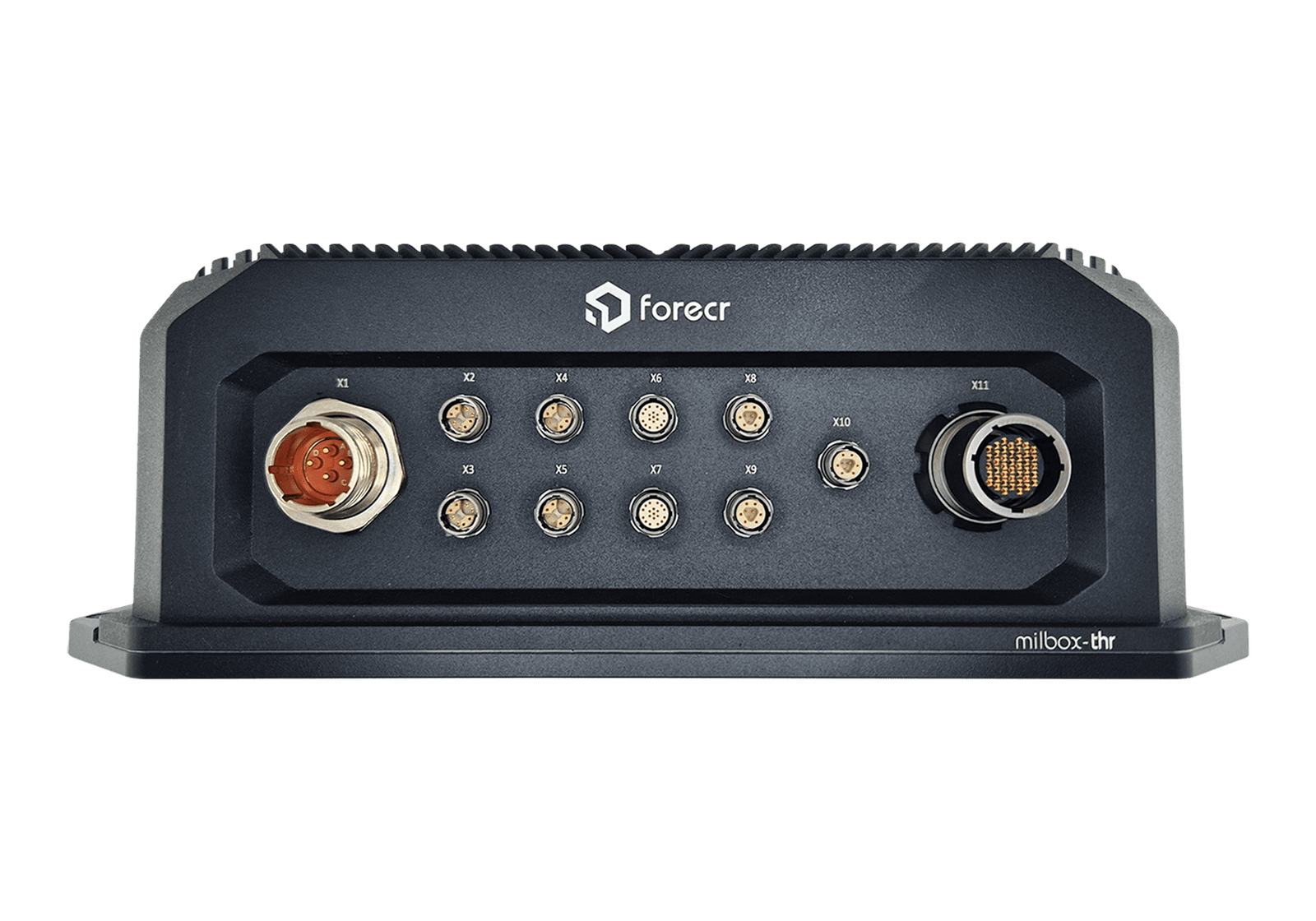
MILBOX-THR
A ruggedized Edge AI computer for defense, avionics and autonomous platforms, with Jetson T4000/T5000 or IGX T5000 options.
View product pageReal-time Edge AI for defense and avionics
Forecr Thor platforms process EO/IR camera, radar, LiDAR and mission data directly in the field. NVIDIA Blackwell architecture brings AI closer to the data source for computer vision, sensor fusion and autonomous decision support.
Avionics and ISR image processing
Object detection, tracking and real-time video analytics across EO/IR, SDI and IP camera streams on Jetson AGX Thor.
Multi-sensor fusion
Combines camera, radar, LiDAR and IMU data in a single Edge AI system to accelerate perception and decision-support workflows.
AI mission computer
Runs perception, sensor-fusion and autonomy software on one system, reducing the need for continuous cloud connectivity.
IGX for mission continuity
IGX T5000 provides a controlled foundation for mission-focused Edge AI systems through full DRAM ECC, real-time Linux and NVIDIA Thor's MIG-based workload isolation.
When should you choose a carrier board or a Box PC?
A carrier board is an integration component for teams building their own mechanical and electrical system around the module. A Box PC brings components together in a computer format. The distinction is not simply an enclosure preference: it affects responsibility for external connections, cooling, power delivery and system verification. Use the existing product cards together with the decision questions below.
| Approach | When to consider it | What to confirm |
|---|---|---|
| DSBOARD-THRMAX | Industrial integration with a custom enclosure and camera architecture. | Carrier connections, cooling solution and target module. |
| DSBOX-THRMAX | An industrial system supplied in a computer format. | Camera expansion, power and mounting limits of the selected configuration. |
| MILBOARD-THR | Board-level integration into a ruggedized system. | Isolated interfaces, connectors and the Jetson/IGX configuration. |
| MILBOX-THR | Integration of a ruggedized computer into a platform. | Final I/O, thermal conditions and program-specific verification. |
A feature described for the family should not be assumed to exist in every variant. In particular, optional camera and video interfaces must match the configuration being ordered.
How do Jetson T4000, T5000 and IGX T5000 differ?
NVIDIA specifies 64 GB for Jetson T4000 and 128 GB for T5000, with respective module power ranges of 40–70 W and 40–130 W. These are not whole-computer consumption figures: storage, the carrier, connected devices and cooling also contribute to the budget. Maximum sparse FP4 compute must not be treated as an application's measured frame rate or end-to-end latency.
For IGX, evaluate industrial software, support and lifecycle requirements separately. NVIDIA's module-compatibility statement does not automatically validate every Forecr configuration. Compare the NVIDIA Thor specifications and Forecr MILBOARD documentation for the same model and revision.
What should you prepare for a technical evaluation?
- List camera count, resolution, frame rate and connection types such as GMSL, SDI or Ethernet.
- Identify the perception model, concurrent workloads and acceptable end-to-end latency.
- Define input power, ambient temperature, cooling, mechanical volume and mounting limits.
- Confirm the target Jetson/IGX module, JetPack/BSP version and peripheral drivers.
- Evaluate field, safety and qualification requirements against the complete system, not the product name alone.
Explore the wider Forecr product portfolio, then use the existing contact link to discuss these requirements with TARGET.
Let us shape your Forecr Thor project together
Review product selection, system architecture and integration requirements for your NVIDIA Jetson- and IGX-based Edge AI project with the TARGET team.



